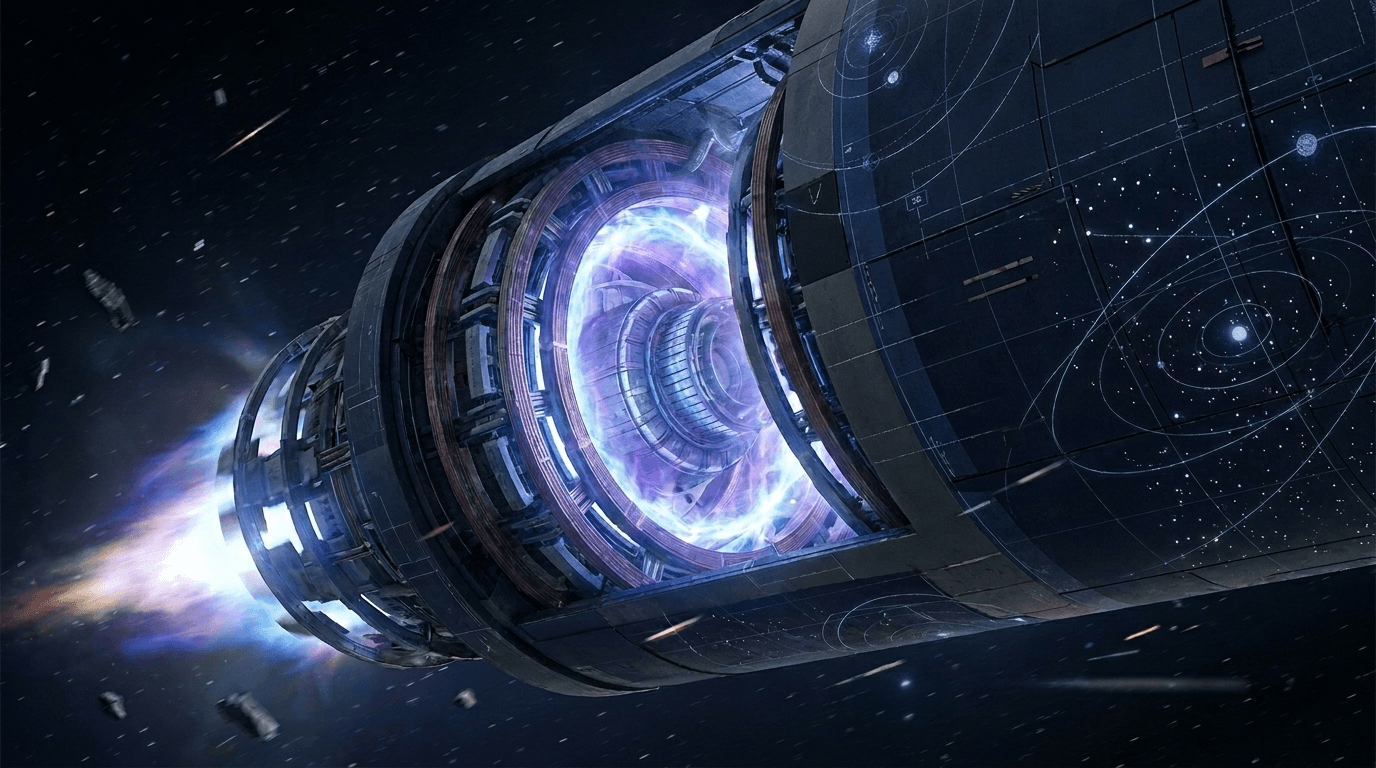
Propulsión de espacio profundo
200 km/s es un umbral significativo para una civilización solar
La libertad solar no necesita comenzar con el uno por ciento de la velocidad de la luz.
Capa visual dinámica
Propulsión de espacio profundo / Visión de investigación e ingeniería de largo plazo.
Módulo 01
Umbral de velocidad
Por qué importan 100-200 km/s
Por qué importan 100-200 km/s
Módulo 02
Escenarios de misión
Bases lunares, Marte, cinturón de asteroides e ingeniería profunda
Bases lunares, Marte, cinturón de asteroides e ingeniería profunda
Módulo 03
Ruta independiente
Una planta terrestre de fusión no es un motor espacial de fusión
Una planta terrestre de fusión no es un motor espacial de fusión
Narrativa de misión
Why 100-200 km/s is already a meaningful threshold for solar-system civilization
The target is not written as 1% light speed because a great deal of solar-system transport, engineering, and base-support work changes character well below that level.
Velocity threshold
Solve solar-system scale first, then talk about farther relativistic stories
Por qué importan 100-200 km/s
The 100-200 km/s range already changes the tempo of Mars transit, asteroid-belt supply, lunar-base logistics, and deep-space robotic work. That makes it a more meaningful engineering threshold for this roadmap.
Mission scenarios
Lunar, Martian, asteroid, and deep-space work all need a durable transport layer
Bases lunares, Marte, cinturón de asteroides e ingeniería profunda
Solar-system freedom is not a single landing event. It is repeated transport, maintenance, assembly, supply, and return capability. Velocity thresholds determine whether that network becomes routine.
Independent path
A terrestrial fusion plant is not a space fusion engine
Una planta terrestre de fusión no es un motor espacial de fusión
Space propulsion must also solve mass, thermal control, radiation, orbital assembly, nozzle design, and life-support constraints. It needs its own aerospace path rather than a direct translation of ground power systems.